

I study evolutionary rates, relationships, and variation across time and space. My current research focuses on the ear region, which includes the organs of hearing and balance and their surrounding bones. It is a highly complex system that provides a trove of information about an organism’s ecology and evolution, but it is poorly known in most animals. To remedy this, I combine classic and novel techniques to improve our understanding of ear region evolution in both living and extinct groups.
Keywords
Comparative anatomy • Evolutionary rates • Morphological variation • Phylogenetics • Ear region • Hoofed mammals



Researchfocus
Studying variation in the ear region of hoofed mammals. The ear region includes structures inside the head, not just the external, fleshy part that we typically think of as “the ear.” I often use CT scans to visualize these internal structures for my research.
Even-toed hoofed mammals (artiodactyls) represent most large-bodied herbivorous and aquatic mammals. Many familiar animals such as cows, deer, goats, camels, and whales are artiodactyls, but the evolutionary relationships among both living and extinct artiodactyl groups remain unclear. I use the ear region to better resolve some of these relationships. In addition, I study how this region evolves in large-bodied mammals. I investigate the variation present, examining how it differs between organisms and over time. Understanding these patterns of variation enables us to make better use of the ear region for various purposes, including delineating species, resolving evolutionary relationships, and studying ecological changes.
Photo © Don Murray, used with permission

Currenttopics
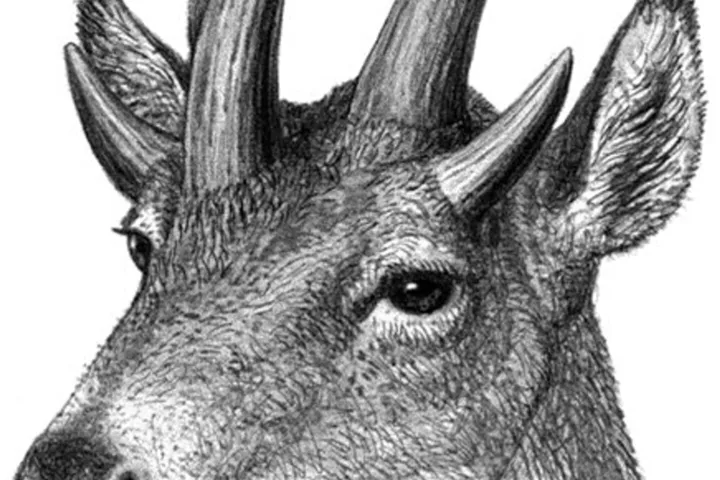
EARSHOT Evolution of the Auditory Region Structures of the Extinct Ruminant Hoplitomeryx
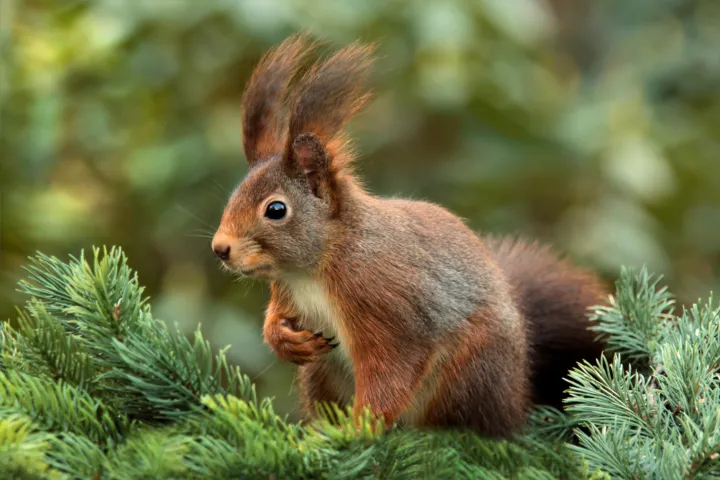
SENSE Squirrel Ecology, Neuroanatomy, and Sensory Evolution
Publications
Robson, S. V., A. Prokop, C. N. Baird, J. A. Ludtke, S. T. Tucker, and J. M. Theodor. 2025. The internal otic region of oromerycids (Artiodactyla, Oromerycidae), early camelids (Artiodactyla, Camelidae), and the vicuña (Artiodactyla, Camelidae), including notes on intraspecific and subadult ontogenetic variation. Integrative Organismal Biology, 7(1), 1-62.
Robson, S. V., & Theodor, J. M. 2025. Is Bunomeryx (Artiodactyla, Homacodontidae) an early tylopod? A re-evaluation of evidence from the otic region, and a clarification of some key anatomical terms. Journal of Vertebrate Paleontology, 44(4), 1-19.
Dillon, E. M., Dunne, E. M., Womack, T. M., Kouvari, M., Larina, E., Claytor, J. R., Ivkić, A., Juhn, M., Milla Carmona, P. S., Robson, S. V., Saha, A., Villafaña, J. A., and Zill, M. E. 2023. Challenges and directions in analytical paleobiology. Paleobiology, 49(3), 337-393.
Robson, S. V., Ludtke, J. A., and Theodor, J. M. 2022. The petrosal and basicranial morphology of Leptoreodon major (Protoceratidae, Artiodactyla). Vertebrate Anatomy Morphology Palaeontology, 9(1), 116-130.
Monarrez, P. M., Zimmt, J. B., Clement, A. M., Gearty, W., Jacisin III, J. J., Jenkins, K. M., Kusnerik, K. M., Poust, A. W., Robson, S. V., Sclafani, J. A., Stilson, K. T., Tennakoon, S. D., and Thompson, C. M. 2021. Our past creates our present: A brief overview of racism in Western paleontology. Paleobiology, 48(2), 173-185.
You can find a complete list of my publications on my Google Scholar page.
In themedia
Check out this blog post about my work, which was recently published in Integrative Organismal Biology. In this project, we described the ear region of oromerycids, an extinct family of North American hoofed mammal. We found compelling evidence that oromerycids are closely related to llamas and camels (yes, llamas and camels are from North America!), and we documented how camel ears have changed over the course of more than 35 million years of evolution.
Photo © Don Murray, used with permission
