

I am enthusiastic about interdisciplinary research. In my studies of mechanical (BSc) and acoustical engineering (MSc) I focused on topics of fluid mechanics and digital signal processing. I was able to apply my engineering skill set to bioacoustics for the first time during my master’s thesis, in which I developed a deep learning model for North Atlantic humpback whale song. Combining digital signal processing and machine learning to apply it to animal vocalizations sparked my excitement and got me thinking about continuing research in a PhD project. I am grateful to be working at the Naturalis Biodiversity Center and hope to use this opportunity to ensure that the technological advancements that we develop are distributed to practitioners and conservation organizations on the ground.
Keywords
acoustical engineering, machine learning, data science, bioacoustics
Researchinterests
Deep learning in bioacoustics is enables non-invasive monitoring on a new scale for a large variety of vocalizing species
The majority of species are still undetectable by state-of-the-art algorithms. Thus, in my PhD I am interested in how we can evaluate and subsequently optimize models to identify unknown bioacoustic sounds. These unknown sounds can be species vocalizations we have never encountered before or sounds that occur rarely and are therefore not included in training datasets.
Passive acoustic monitoring captures highly diverse soundscapes, but we are currently only able to identify a small fraction of the sounds. The aim of my PhD project is to use deep learning in bioacoustics not only to detect the species we know, but also help us find new ones.


Currenttopics
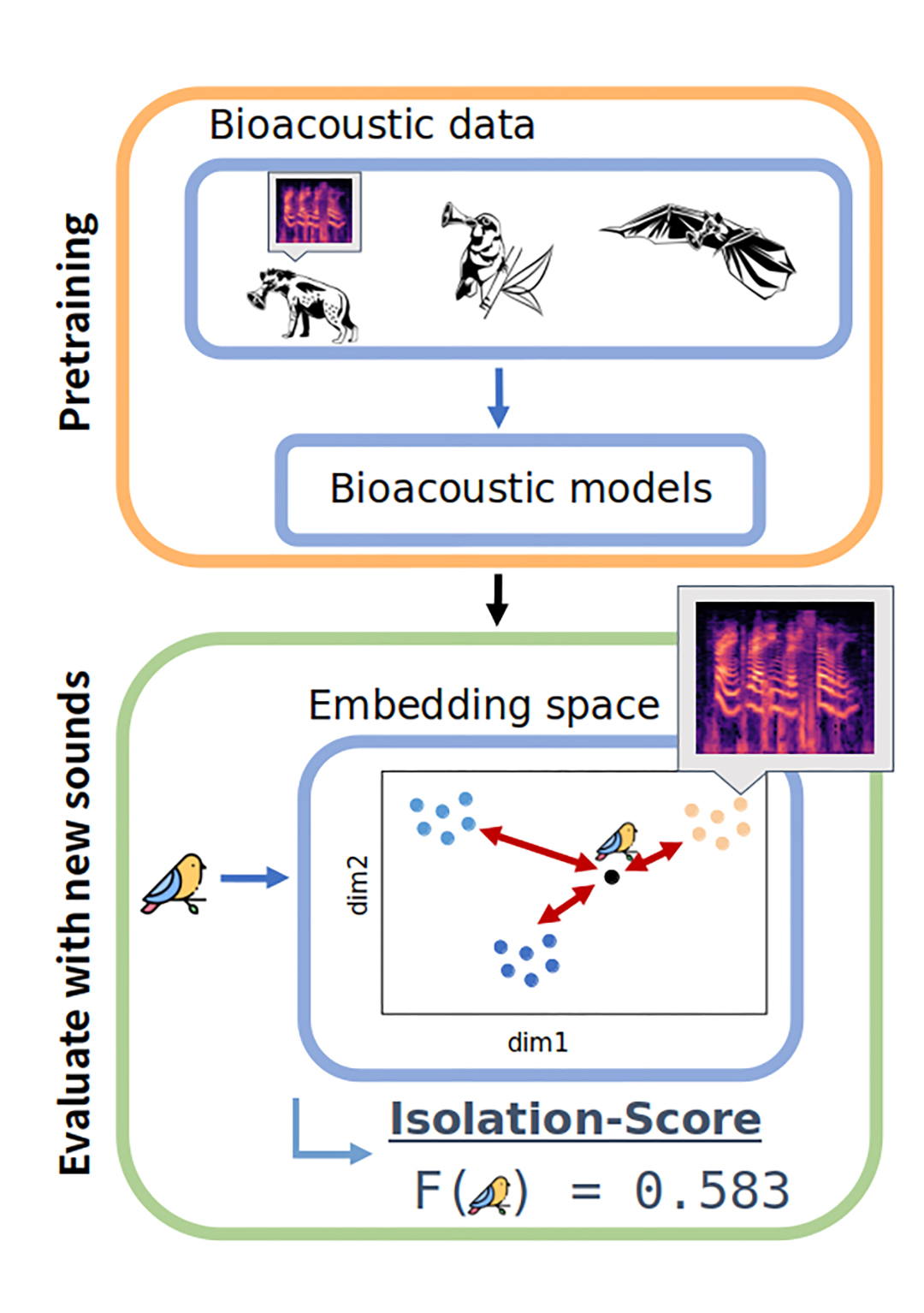
Evaluating state-of-the-art bioacoustic deep learning models in their ability to isolate unknowns.
I focus on the embeddings generated by models rather than their classifier performance. Investigating if a model is able to isolate animal vocalizations that are not included in the model’s training data is my current research focus. Existing clustering metrics like Adjusted Rand Index (ARI), Adjusted Mutual Information (AMI) or the Silhouette Score allow to quantify clusterings of embeddings, but their interpretability for specific tasks is limited. Combining these clustering metrics with qualitative exploration of embedding spaces, I aim to research new metrics to benchmark the performance of state-of-the-art models in this specific task and identify promising training setups.
Key publications
Kather, Vincent S., et al. "bacpipe: a Python package to make bioacoustic deep learning models accessible." arXiv preprint arXiv:2604.11560 (2026). DOI
Kather, Vincent S., Burooj Ghani, and Dan Stowell. "Clustering and novel class recognition: evaluating bioacoustic deep learning feature extractors." Proceedings of the 11th Convention of the European Acoustics Association Forum Acusticum / EuroNoise 2025. DOI
Kather, Vincent, et al. "Development of a machine learning detector for North Atlantic humpback whale song." The Journal of the Acoustical Society of America 155.3 (2024): 2050-2064. DOI