

I study the evolution and ecology within terrestrial habitats, especially islands. Islands - either classical oceanic islands, mountain peaks, or alkaline limestone outcrops surrounded by acidic forest soils - are interesting for the study of evolution because they are discrete geographical entities with clear boundaries, making the study of its many unique species relatively easy. Furthermore, evolution tends to be more pronounced on islands compared to continents, with many island species evolving extreme traits, such as gigantism and dwarfism. The best known example of gigantism in plants is derived woodiness, implying that small herbaceous species evolved to larger shrubs or even trees after colonizing the islands. I am currently doing a postdoc to build the Tree of Life of the mustard family (Brassicaceae) to investigate why herbaceous lineages evolved so frequently into woody species
Keywords
Island evolution, biogeography, derived woodiness, Brassicaceae, next generation sequencing, phylogenetics
Researchinterest
As a postdoc researcher at Naturalis (and previously University of Osnabrück, Germany), I am working on the evolution of derived woodiness in the Brassicaceae plant family.
Most of the ~4000 species within the Brassicaceae plant family are herbaceous. However, about 400 species have evolved into shrubs or lianas. Interestingly, all the woody species have derived from herbaceous relatives, and result from about 100 independent evolutionary transitions. This case of massive, parallel evolution can teach us about what drives the evolution of woodiness. Using the latest next generation sequencing techniques, I am building the Brassicaceae Tree of Life to identify the ca. 100 transitions towards woodiness and to infer the influence of woodiness on species diversification.


Currenttopics
A selection of the topics I am working on currently.
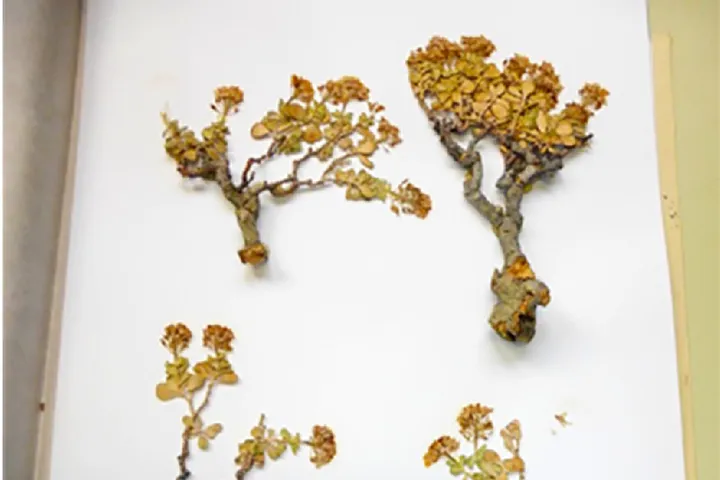
Exploring massive parallel evolution and diversification of derived woodiness in the Brassicaceae
Keypublications
Hendriks, Kasper P, Christiane Kiefer, Ihsan A Al-Shehbaz, et al. 2023. ‘Global Brassicaceae Phylogeny Based on Filtering of 1,000-Gene Dataset’. Current Biology 33 (19): 4052-4068.e6. https://doi.org/10.1016/j.cub.2023.08.026
Hendriks, Kasper P, Terezie Mandáková, Nikolai M Hay, et al. 2021. ‘The Best of Both Worlds: Combining Lineage-Specific and Universal Bait Sets in Target-Enrichment Hybridization Reactions’. Applications in Plant Sciences 9 (7). https://doi.org/10.1002/aps3.11438
Dominicus, Lisa J M A, Ihsan A Al-Shehbaz, Dmitry A German, ..., Kasper P Hendriks. 2025. ‘Mitoplastomic Discordance in Brassicaceae Phylogenomics Confirms the Complex Evolutionary History of the Family’. Annals of Botany, mcaf084. https://doi.org/10.1093/aob/mcaf084
German, Dmitry A, Kasper P Hendriks, Marcus A Koch, et al. 2023. ‘An Updated Classification of the Brassicaceae (Cruciferae)’. PhytoKeys 220: 127–44. https://doi.org/10.3897/phytokeys.220.97724
Zuntini, Alexandre R., Tom Carruthers, Olivier Maurin, ..., Kasper P Hendriks, et al. 2024. ‘Phylogenomics and the Rise of the Angiosperms’. Nature, 1–8. https://doi.org/10.1038/s41586-024-07324-0
Merckx, Vincent S F T, Kasper P Hendriks, Kevin K Beentjes, et al. 2015. ‘Evolution of Endemism on a Young Tropical Mountain’. Nature 524 (7565): 347–50. https://doi.org/10.1038/nature14949
Castillo-Lorenzo, Elena, Kasper P Hendriks, Flora Gilmour, et al. 2025. ‘A Phylogenetic Approach to Prioritizing Crop Wild Relatives in Brassiceae (Brassicaceae) for Breeding Applications’. Annals of Botany, mcaf201. https://doi.org/10.1093/aob/mcaf201
Hay, Nikolai M, Michael D Windham, Terezie Mandáková, Martin A Lysak, Kasper P Hendriks, et al. 2023. ‘A Hyb-Seq Phylogeny of Boechera and Related Genera Using a Combination of Angiosperms353 and Brassicaceae-Specific Bait Sets’. American Journal of Botany 110 (10): e16226. https://doi.org/10.1002/ajb2.16226
Kiefer, Markus, Dmitry A German, Christiane Kiefer, Kasper P Hendriks, et al. 2025. ‘Capacity Building in Crucifer Research—from BrassiBase to a Taxonomic Expert Network (BrassiTEN)’. Plant Systematics and Evolution 311 (5): 30. https://doi.org/10.1007/s00606-025-01964-z
Mabry, Makenzie E, R Shawn Abrahams, Ihsan A Al-Shehbaz, ..., Kasper P Hendriks, et al. 2023. ‘Complementing Model Species with Model Clades’. The Plant Cell, koad260. https://doi.org/10.1093/plcell/koad260
Thomas, Shawn K, R Shawn Abrahams, Daniel Robert Kick, ..., Kasper P Hendriks, et al. 2025. ‘Mesopolyploidy as a Taxonomic Clade Marker for Brassica and Relatives (Tribe Brassiceae)’. Annals of Botany, mcaf170. https://doi.org/10.1093/aob/mcaf170
Teachingactivities
I am actively involved in the supervision of international master students.
I have travelled to Borneo with students various times, teaching about evolution and fieldwork in the tropics.


In themedia
In 2012, I joined a large expedition to Mount Kinabalu & the Crocker Range on Borneo. The aim of the expedition, jointly organized by Naturalis and Sabah Parks, was to collect species new to science, and to reconstruct the general evolutionary patterns of plants and animals on the slopes of the mountain. The expedition was widely covered in the international media, such as Science, National Geographic, and various newspapers, and resulted in a letter in Nature.
