

Bringing people and nature together in the heart of the city. What factors need to be considered, and what steps are required to create a truly nature-inclusive urban garden? Naturalis commissioned Delft University of Technology to develop a framework to answer these questions.
Green embassyin Berlin
At the request of the Dutch Embassy in Berlin, Naturalis and the Urban Ecology Design department at TU Delft have outlined the steps required to create a nature-inclusive urban garden that enhances biodiversity and improves the quality of life for people. We have therefore developed a practical guide to help people create their own nature-inclusive urban garden. This guide is currently being implemented at the embassy in Berlin.
Guidelinesfor nature-inclusive design
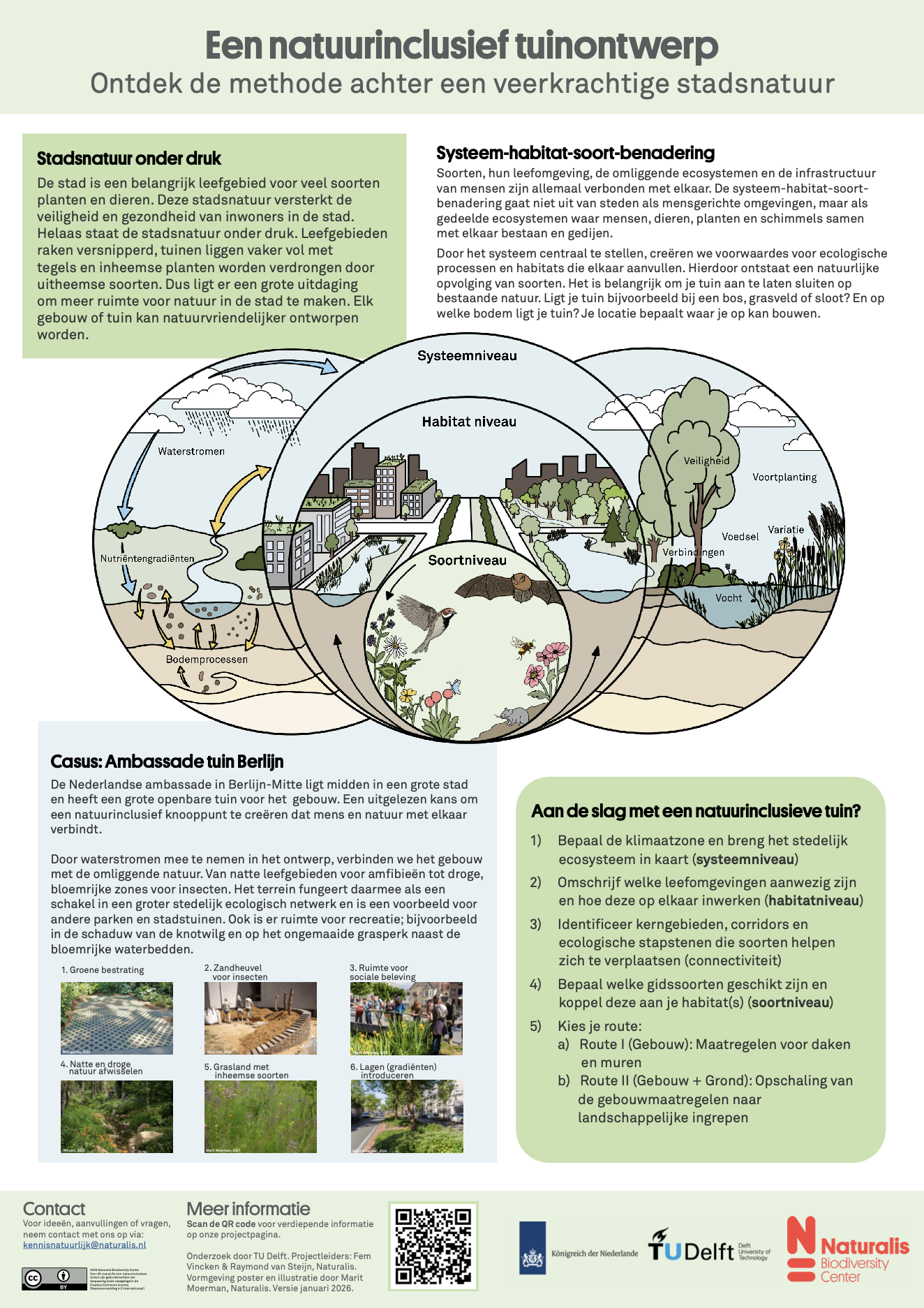
Designing urban environments to be nature-inclusive is crucial for making them resilient and liveable. However, it can be challenging to know where to start and which steps to take. According to Fem Vincken, junior project manager at Naturalis, that is why a concrete, transferable knowledge product is needed. "We have translated the insights and methodologies we used to create the Embassy Garden in Berlin into a strategic roadmap, which we have produced as a poster and a detailed brochure."
These provide guidance on the nature-inclusive design of urban gardens. “We want to inspire every public urban garden to take nature-inclusive steps towards a greener, healthier and more sustainable urban future,” says Vincken.

Knowledgeproducts
Poster: Strategic Roadmap
Based on our in-depth research, this visual guide provides clear guidance on the focus and implementation of nature-inclusive urban gardens.
The brochure
A comprehensive brochure is also available, providing a thorough understanding of the applied principles and solutions. Using the Dutch Embassy Garden in Berlin as a case study, it contains detailed information on ecological considerations, material choices, and design principles. It serves as a best practice guide and source of inspiration for similar projects within your organisation or local authority. Each step is explained and can be adapted for other gardens.
A holistic viewof biodiversity
Our approach is based on the ‘system-habitat-species’ method, which considers the interconnectedness of species rather than focusing on them individually. This method creates dynamic, biodiverse urban ecosystems by recognising the interconnections between them.
This integrated approach guarantees that our designs are not only aesthetically pleasing, but also contribute to the ecological resilience and functionality of urban areas.

The ‘system-habitat-species’method
The basis of a suitable habitat
Every species has specific habitat requirements. The 'system-habitat-species approach' optimises environmental factors to facilitate a wide range of habitats. To develop ecologically healthy habitats, Naturalis promotes considering the six Vs: Food, water, safety, reproduction, connection and variation. This approach puts the full life cycle and habitat needs of species at the centre.
The power of connected ecosystems
This approach recognises the fundamental interconnectedness between species, habitats, surrounding ecosystems, and human infrastructure. By focusing on the entire system, we create conditions that allow robust ecological processes and natural species succession to flourish. The underlying ecosystem provides the foundation for diverse habitats to emerge, with the habitats and species present reinforcing one another synergistically.
Who is workingon this?
This project is a collaboration between Naturalis and Delft University of Technology (represented by Nico Tillie), the Dutch Embassy in Berlin (represented by Merijn Bos), and the Ministry of Foreign Affairs.


In theMedia
In June 2025, we organised a kick-off event as part of the 'Langer Tag der Stadtsnatur'. Through a BioBlitz, we increased public engagement and support for nature-inclusive urban planning.
Photo: © Stiftung Naturschutz Berlin / Christina Koormann
