

We are looking for a master student to contribute to the development of a comparative reference dataset for laminated geological structures. The project will focus on abiotic laminated materials, including evaporites, speleothems, travertines, mineral crusts, veins, agates, malachite, and other chemically precipitated or diagenetic structures.
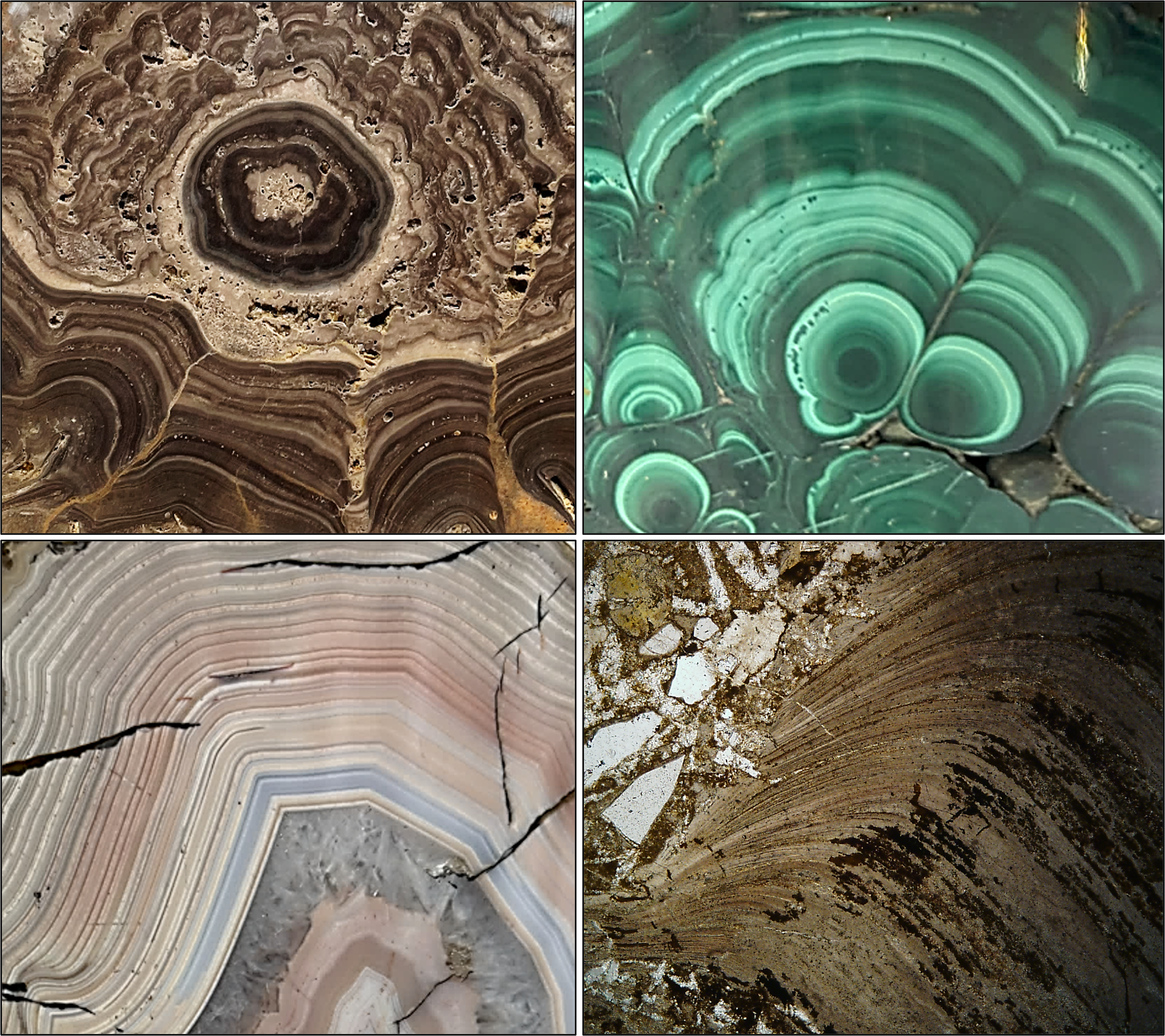
Examples of biotic and abiotic lamination in geological samples.
Backgroundand context
Lamination is a common feature in many geological materials and can form through a wide range of biological, chemical, and physical processes. The scientific goal is to identify which combinations of morphological, petrographic, mineralogical, geochemical, and 3D criteria characterize abiotic lamination, and how these criteria can be compared with stromatolite lamination in the context of biosignature interpretation.
This internship project is part of the broader HFSP project “Unambiguous Biosignatures for Life Detection”, led by Dr. Mark van Zuilen, Dr. Sean McMahon, and Prof. Henderson Cleaves. The overall project aims to build an extensive, high-quality database of ancient biosignatures in rock formations relevant to both Earth and extraterrestrial environments.
This internship project is designed to complement ongoing work on stromatolites by developing the abiotic reference side of the comparison. The successful candidate will be part of Dr. Mark van Zuilen’s research team in the Earth, Life, Time Group at Naturalis Biodiversity Center, Leiden, and will work under the supervision of postdoctoral researcher Dr. Laurane Fogret.
Objectivesand goals
The expected outcome is a curated multimodal dataset of abiotic laminated structures and a preliminary interpretive framework for comparing abiotic and stromatolitic lamination. The computational segmentation, feature extraction, and machine-learning analyses will be developed by a separate technical researcher. The student will interact with this computational work package by helping define meaningful geological descriptors and, later in the project, by using the extracted measurements to formulate hypotheses about how abiotic laminated structures compare with stromatolites.
Materialsand methods
The successful candidate will work in close collaboration with geologists and astrobiologists to build the foundation of the abiotic reference dataset. The student will work with samples from the Naturalis Museum and Utrecht University collections, complemented by selected open-access image resources. The work will include :
- selecting relevant samples,
- documenting their geological context,
- acquiring high-quality images,
- describing thin sections,
- conduct additional µXRF and µCT analyses.
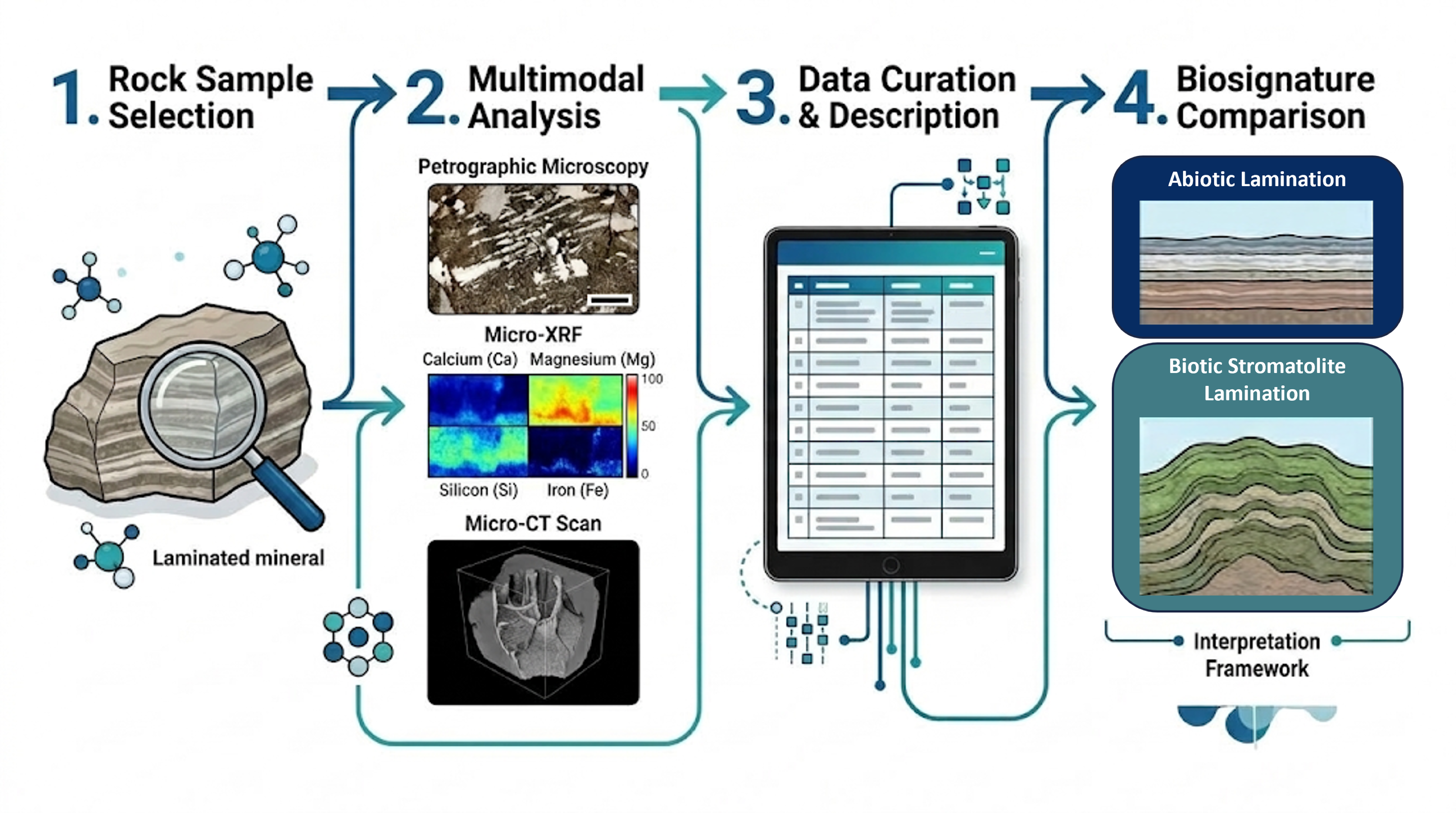
Methodological workflow for identifying biosignatures in laminated rocks.
Studentrequirements
- Experience with petrographic microscopy or thin-section description would be an advantage.
- Experience with programming languages (Python, Julia, Matlab).
- Interest in imaging techniques such as macrophotography, micro-XRF, or micro-CT.
- Strong written and verbal communication skills in English.
- Ability to organize datasets in a clear and structured way.
- Ability to work independently while interacting with an interdisciplinary research team.
Procedure
Applicants are invited to submit their application in one pdf, including a cover/motivation letter (max.1 page) and a resume (max. 2 pages), addressed to Laurane Fogret: laurane.fogret@naturalis.nl.