

Biodiversity and biodiversity loss are concepts set to play an increasingly important role in urban development, particularly in the long term. This is why area developer BPD | Bouwfonds Gebiedsontwikkeling asked: 'Which factors within urban area development influence the basic quality of nature (Basiskwaliteit Natuur - BKN)?' Daan Posthouwer of Nest Natuurinclusief took on this task.
A lookahead
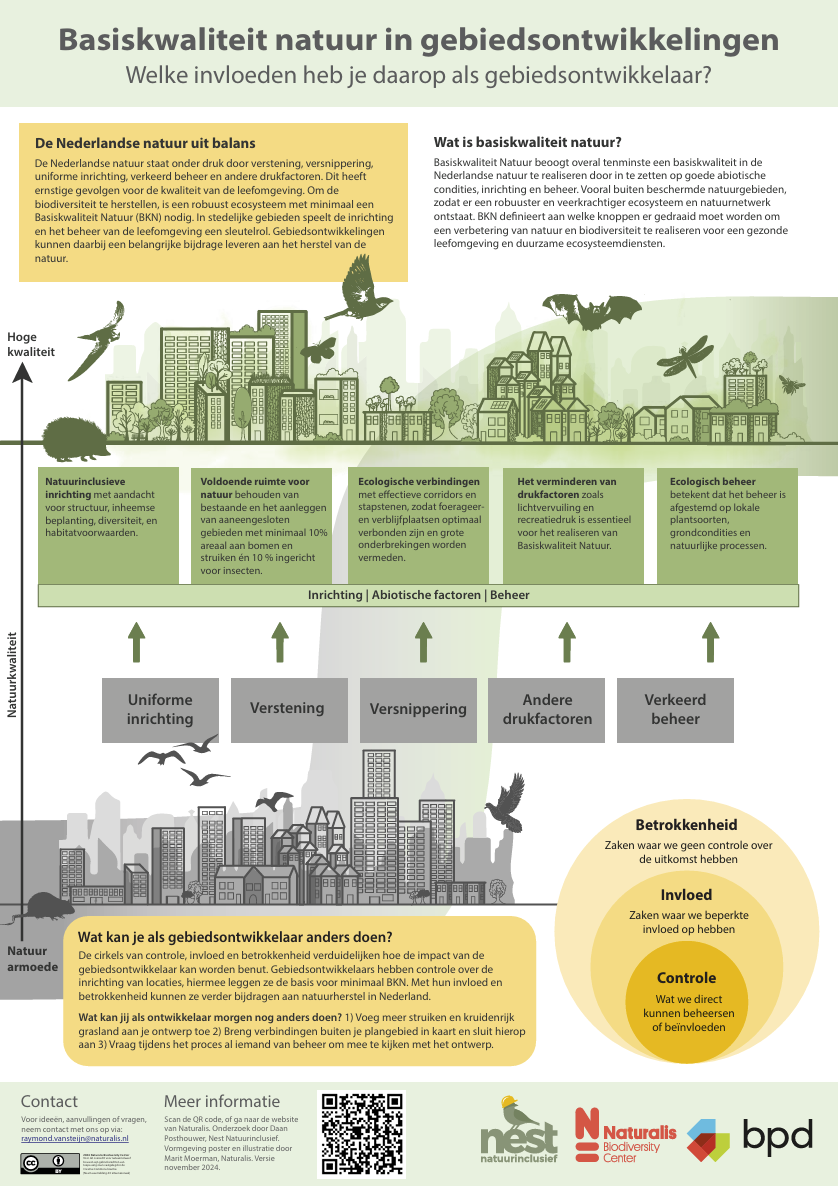
Many area development projects, such as housing developments in the rental and owner-occupied sectors, adopt a long-term approach. When developing residential areas, values such as sustainability, quality of life, and social awareness therefore play a major role. A key concept for designing nature effectively and in a future-proof manner within area development is Basic Nature Quality (Basiskwaliteit Natuur - BKN). BKN refers to the totality of conditions within a landscape (including landscape design, abiotic factors and management) that enable widespread species of plants and animals to remain so. BPD aims to contribute to the restoration of nature in the Netherlands by designing biodiverse, green residential areas. It therefore posed the question: 'Which factors within urban area development influence Basic Nature Quality (Basiskwaliteit Natuur - BKN)?'
New standard
In order to answer this question, it was first necessary to examine the following: 'What does "Basic Quality of Nature" mean in an urban context?', before determining 'How do you, as an area developer, contribute to Basic Quality of Nature in the Netherlands?'. The research resulted in an overview of five key points and an assessment framework for BPD. This framework can be used to measure and, where necessary, adjust the impact of construction projects and area development on biodiversity. 'The developer plays a key role in achieving BKN. How do you obtain the right information from the ecologist, and how do you ensure it is properly integrated into the project?' The assessment framework can be a great help here,' says Posthouwer.


BKNguarantees
Rens de Boer, BPD's strategic advisor on nature and landscape, explains how they can implement the assessment framework: "It is an important tool for monitoring and halting the decline of nature. How can we ensure that species that are still common today, such as blackbirds and house sparrows, remain so and do not decline further? The answer varies depending on whether we are in the city or the countryside, or on the Wadden Islands or in Limburg. It will be an important tool for our developers. With the assessment framework, they can create conditions that ensure we do not fall below crucial thresholds.” Posthouwer is also positive about how area developers can use this approach to guide BKN. "Thanks to this collaboration between Naturalis, Nest and BPD, well-considered choices can now be made when developing an area that contributes to strengthening Dutch biodiversity."
Get startedyourself
View the poster here (dutch)
View the report here (dutch)